
Following the RAF's Engineers from Training to Operations
By Leon Leenders, Video Producer
Two weeks after we packed up our kit and flew home from RAF Akrotiri in Cyprus, the airbase was hit by a drone. I read the news from my desk in the UK and it brought something home very quickly: we had been standing exactly there.
We knew the risks going in. We had risk-assessed the trip. The situation across the Mediterranean was uncertain and we'd signed waivers to work in environments with explosives. That's exactly the kind of work our team is built for and it's why RAF Specialist Recruitment came to us in the first place.
This is the story of a project of six films, three specialist trades, and a brief that could have been fulfilled with simple interviews, but we chose not to.
The brief showed urgency. RAF Specialist Recruitment supports thirteen specialist trades and recruitment for engineering roles is genuinely hard. This year their targets rose by around 30%, and it was their last campaign before the function transferred to a new provider. They wanted to go out with a bang.
We could have satisfied that brief with a talking head and some b-roll per trade. Instead, we built each main video around engineers at multiple stages of their career: the trainee, the apprentice, and the qualified engineer.
That decision multiplied the difficulty enormously, but it's what gave the films their depth. To me, that's the difference between a recruitment video that shouts out some promises and one that feels realistic enough for an eighteen-year-old to think: “That could be me.”
We planned rigorously so we could improvise freely
How do you keep one coherent narrative across six films, seven locations, and fifteen interviews with people you've never met, doing activities you often can't predict until you arrive?
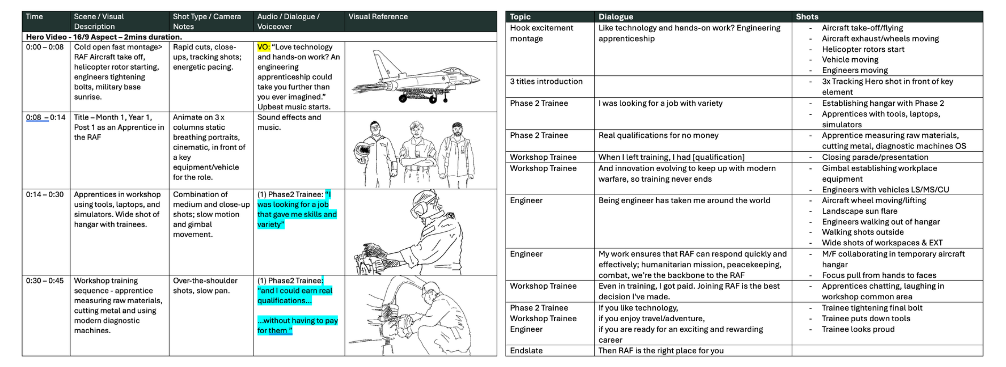
We laid out the foundations first: a storyboard and a table. For every video, we mapped the narrative beats we needed, the dialogue we hoped to capture, and the ideal shots to tell each part. I'm aware that this sounds rigid. In practice, it's precisely what lets us be flexible. Each shooting day, we would arrive at an airbase, see who and what was available, then look back at our narratives and ask: where does this person or this activity fit?
One small example I'm proud of: a single shot of engineers working on vehicles, the camera gliding left to right to reveal the sheer variety of the trade. That shot was assembled from footage gathered across several weeks and locations. I knew I wanted that movement, so every shoot day, I made sure I had the pieces to build it.
Takeaway: Planning and spontaneity aren't opposites. The more thoroughly you map your story in advance, the more freely you can adapt when reality surprises you on the day, which it always does.
We flew to Cyprus to be in the real action
Each trade had its own creative focus: action for the Aircraft Technician Weapons role, variety for the Vehicle and Mechanical Equipment Technicians, cutting-edge innovation for the Advanced Manufacture Repair Technicians. For ‘action’, you can't stage the real thing in an exercise in the UK, so we went to an operational environment overseas.
Filming there meant working entirely to the base's tempo. Operations don't pause for a film crew, so we were ready to shoot at any hour, kit prepped, watching for the moment a Typhoon was prepared for its mission. Being trusted to genuinely be part of that operational picture is what separates footage that feels authentic from footage that merely looks the part.
Takeaway: Authenticity has a cost in time, planning, and risk. When the story depends on it, that cost is worth paying. Audiences can always tell the difference.
What we took away
The films are now live on the RAF's recruitment website. We don't have the numbers yet, but the real measure of this project will be to see how many young people see themselves in these engineers and take up the challenge
Overall, there's one outcome I already know. Across those months, we spent our days alongside RAF engineers, learning just how much their work involves and how fascinating the people are. By the end, Tom, our junior video producer, was half-seriously wondering whether he should join up himself. If even the crew starts to want the job, that's the truest review a recruitment film can get.
That's why we go the extra mile. Every time we pushed a little further on this project, we got far more back. More than any single shot, that is the work we're proudest of.